On Binary Options
We investigate the interesting case of binary options, looking at how defining the rebate in foreign or domestic terms changes the payoff when looking at it from the traditional, domestic point of view. We show how a binary option is not necessarily a step function when this change in perspective is implemented. We then apply this thinking to the case study of european knock-in/out options and see how they can be built and shown to be equivalent. Finally, we show the transformation needed to move between the two binary options.
1 Background
Binary (or digital) options are an interesting topic. At first glance they work by providing an all-or-nothing payoff \(D\) when the reference price \(S\) is above a threshold \(T\): \begin{equation} \label {eqn:dom_binary_payoff} B_{\text {domestic}} = \begin {cases} D & S \geq T \\ 0 & S<T \end {cases} \tag{1.1} \end{equation}
Of course, we note that the payoff is given in terms of the currency of whatever we are discussing, for instance in foreign exchange markets its given by the domestic currency (e.g. paying/receiving USD in GBPUSD) and in commodities it is given by the contract currency (e.g. paying/receiving GBP in London Cocoa QC).
However, we may want to define a binary option in the other quantity, paying/receiving GBP in the cable example and cocoa beans in QC. While the first example comes more naturally to us than the second, the analogy stands, simply we are not used to thinking as cocoa beans as a type of barter with which we may transact sterling.
This second binary option is known as a Foreign Binary, as it pays out the foreign currency in the FORDOM FX world. To be more explicit in our terminology we will refer to the original binary as a Domestic Binary. Showing how these two are related to one another is the purpose of this piece of work.
2 Payoffs
The payoff of a domestic binary is given by Eq. 1.1 while for a foreign binary: \begin{equation} \label {eqn:for_binary_payoff_domfor} B'_{\text {foreign}} = \begin {cases} F & S' \leq T' \\ 0 & S' > T' \end {cases} \tag{2.1} \end{equation} where \(F\) is the payoff in the foreign currency and \(S'\), \(T'\) are the DOMFOR equivalents of the previously defined \(S\) and \(T\), i.e. their reciprocals. Then, the payoff in a FORDOM world becomes: \begin{equation} \label {eqn:for_binary_payoff} B_{\text {foreign}} = \begin {cases} FS & S \geq T \\ 0 & S < T \end {cases} \tag{2.2} \end{equation}
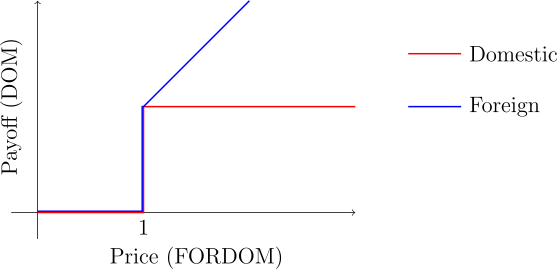
Clearly, we may note that these will not look the same when drawn on a payoff graph whose \(x\)-axis is given by the reference price \(S\) (FORDOM) and \(y\)-axis is given in terms of the domestic currency, see Fig. 2.1. This occurs as the foreign currency payoff must be converted into the domestic currency using the reference price \(S\), resulting in a varying domestic payoff \(\sim x\).
3 European Knock-In/Out Options
Domestic Options
When constructing a European knock-in/out option we make use of binaries, for the sake of completeness see how they are constructed below, we use the common notation strike \(K\) and barrier \(E\):
-
\(+1\) European knock-in call, \(E>K\):
- \(+1\) European call at \(E\);
- \(+1\) European domestic binary call at \(E\) with rebate \(K-E\).
-
\(+1\) European knock-out call, \(E>K\):
- \(+1\) European call at \(K\);
- \(-1\) European call at \(E\);
- \(-1\) European domestic binary call at \(E\) with rebate \(K-E\).
The put version can be thus trivially written down. What is important to note is that these have been given in terms of terms of FORDOM with payoffs given by DOM. This becomes slightly trickier when the user’s systems work in the FORDOM space but the user has to price in terms of a DOMFOR quote. We will now look at how to construct a DOMFOR European knock-in/out option in a FORDOM world.
Foreign Options
There are a few subtleties when constructing these, which have to do with the rebate of the foreign binary (as one can imagine) and the quantity of each leg that we need. We first start off by imagining the scenario in a DOMFOR world, we have the exact situation above but for a put option and all strikes are reciprocals ( \('\) notation as previously utilised). We note that the quantities are the same in this hypothetical scenario but they represent FOR units instead of the DOM units used earlier.
Having done this, we may convert them into the FORDOM world:
-
\(+\frac {1}{K}\) European knock-in call, \(E>K\):
- \(+\frac {1}{E}\) European call at \(E\);
- \(+\frac {1}{E}\) European foreign binary call at \(E\) with rebate \(\frac {K-E}{K}\).
-
\(+\frac {1}{K}\) European knock-out call, \(E>K\):
- \(+\frac {1}{K}\) European call at \(K\);
- \(-\frac {1}{E}\) European call at \(E\);
- \(-\frac {1}{E}\) European foreign binary call at \(E\) with rebate \(\frac {K-E}{K}\).
What we immediately notice is that now the original quantities are less utilisable, therefore instead of having just \(1\) FOR unit we can use \(K\) FOR units of each call to simplify the above:
-
\(+1\) European knock-in call, \(E>K\):
- \(+\frac {K}{E}\) European call at \(E\);
- \(+1\) European foreign binary call at \(E\) with rebate \(\frac {K-E}{E}\).
-
\(+1\) European knock-out call, \(E>K\):
- \(+1\) European call at \(K\);
- \(-\frac {K}{E}\) European call at \(E\);
- \(-1\) European foreign binary call at \(E\) with rebate \(\frac {K-E}{E}\).
In addition, we have simplified the quantity and rebate of the binary (they are in essence the same thing of course, so we can set either equal to one and take the product of what they were before as the other).
It is then straight forward to verify that these are equivalent to the domestic example. For instance by analytically checking the behaviour at different scenario points, or somewhat more efficiently, by graphing the payoff profiles.
We have thus shown that \(1\) DOM worth of European knock-in/out options with strike \(K\) and barrier level \(E\) is equivalent to \(K\) FOR worth of the same structure.
4 Final Remark
In Sec. 1 we stated that the goal of this piece of work was to show the relation between these two instruments. We will now show this.
Going back to Fig. 2.1 it does not require much intuition to notice how the foreign binary has a shape that resembles the payoff of a European knock-in option. By going back to our European knock-in option case study, we may easily determine what the equivalence relation is: \begin{multline} \left (\text {EU C } @ \, E \right ) + \left (K-E\right ) \left (\text {EU DOM Bin C } @ \, E \right ) \\ = \frac {K}{E} \left (\text {EU C } @ \, E \right ) + \left ( \frac {K-E}{E} \right )\left (\text {EU FOR Bin C } @ \, E \right ) \tag{4.1} \end{multline} \begin{equation} \left (\text {EU DOM Bin C } @ \, E \right ) = \frac {1}{E} \left [\left (\text {EU C } @ \, E \right ) + \left (\text {EU FOR Bin C } @ \, E \right )\right ] \tag{4.2} \end{equation} where we have implicitly assumed that the rebate is \(1\) for all binaries (in their respective currencies).